Standard Lightfastness Testing Methods for Printed Packaging Substrates
Standard lightfastness testing protocols evaluate printed packaging fade resistance using xenon arc weathering chambers calibrated to ASTM D3424 and ISO 12040 standards.


Exposure
Standardized bench methods evaluate how printed packaging withstands radiant energy over extended commercial shelf life. Packaging substrates pass through distribution channels where ambient sunlight, indoor fluorescent fixtures, and high-intensity LED display cases drive photolytic decay. Uncontrolled radiation breaks down ink vehicle polymers, degrades organic pigment chromophores, and alters substrate reflectance.
Selecting an exposure framework requires matching artificial light sources, optical filter combinations, and chamber climate parameters to real-world retail environments.
The primary baseline standards governing printed matter lightfastness include ASTM D3424 and ISO 12040. Standard test apparatuses simulate specific lighting conditions by altering optical filtration. Method 3 of ASTM D3424 employs a xenon-arc lamp filtered through window glass, reproducing indoor indirect daylight typical of retail stores and warehouse interiors.
Method 4 applies daylight filters to simulate unfiltered exterior exposure during transit or outdoor display. Lightfastness measures photolytic resistance. Enclosed carbon-arc systems, previously specified in legacy protocols, exhibit spectral energy mismatches in the ultraviolet spectrum below 350 nanometers.
Modern testing relies on xenon-arc apparatus conforming to ASTM G155 or ISO 4892-2.
Laboratory light source selection dictates test speed and accuracy. Xenon-arc lamps supply a continuous emission spectral energy distribution that closely matches natural sunlight across ultraviolet and visible wavelengths. Water-cooled xenon burners maintain high irradiance stability across multi-week test cycles, whereas air-cooled tubes offer lower operational overhead for routine quality control.
Fluorescent UV chambers operating under ASTM G154 target polymer degradation rather than visual color shift. Fluorescent lamps emit concentrated ultraviolet energy without providing the visible spectral spectrum necessary to assess color change in visible inks.
| Standard Designation | Light Source Type | Optical Filter Set | Control Irradiance (W/m² @ 340nm) | Black Panel Temp (°C) | Target Packaging Application |
|---|---|---|---|---|---|
| ASTM D3424 Method 3 | Xenon Arc | Window Glass | 0.55 | 63 ± 3 | Indoor folding cartons and retail packaging |
| ASTM D3424 Method 4 | Xenon Arc | Daylight Glass | 0.68 | 63 ± 3 | Outdoor agricultural bags and transit labels |
| ISO 12040 | Xenon Arc | Window Glass Filtered | 0.55 | 55 ± 2 | European graphic arts and consumer packaging |
| ISO 105-B02 | Xenon Arc | Window Glass Filtered | 1.10 (420nm) | 65 ± 2 | Textile and flexible barrier packaging materials |
Chamber environmental control standards prevent thermal degradation from skewing light-induced color shifts. Test cabinets regulate internal airflow and cabinet temperature to mirror retail shelf microclimates. Elevated sample temperatures accelerate heat-driven chemical reactions that do not occur at ambient store temperatures of 20°C to 23°C. Black panel thermometers monitor specimen surface heating caused by infrared radiation.
Controlling relative humidity inside the chamber prevents moisture-sensitive inks and coated papers from swelling or chalking during light exposure.
Xenon arc chambers operating at 0.55 W/m² at 340 nanometers generate cumulative radiant exposure of 1.98 megajoules per square meter over a continuous 100-hour test run.
Executing an accelerated lightfastness evaluation demands strict sequence adherence across specimen preparation, chamber calibration, exposure monitoring, and post-exposure conditioning.
- Cut test specimens from printed packaging substrates to fit specimen holders measuring 70 millimeters by 145 millimeters, excluding distorted edges or fold lines.
- Mount control specimens in light-tight storage envelopes held at 23°C and 50 percent relative humidity to serve as unexposed baseline references.
- Calibrate the xenon lamp irradiance sensor using a certified radiometer operating at 340 nanometers or 420 nanometers prior to launching the test series.
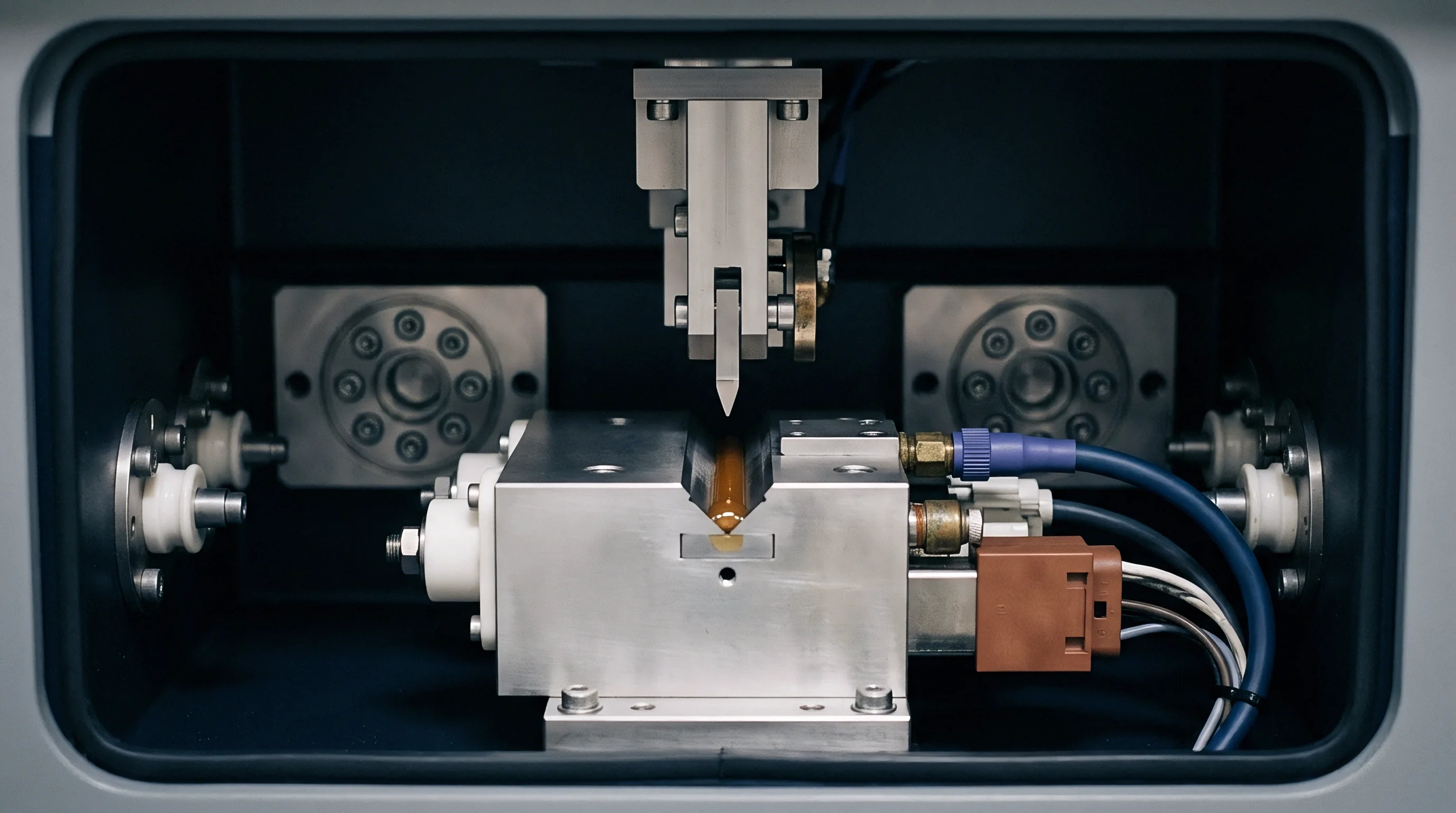
- Install specimens alongside Blue Wool Reference Strips in the rotating specimen rack, ensuring specimen surfaces maintain uniform distance from the central burner tube.
- Program chamber parameters to maintain a black panel temperature of 63°C and relative humidity of 50 percent under continuous illumination without water spray cycles.
- Interrupt exposure at specified interval steps to measure color change spectrophotometrically before returning specimens to the test chamber.
Technical specifications written into converter purchase agreements often incorporate ASTM D3424 Section 9.3 clauses defining allowable color change thresholds of Delta E DE2000 under 2.0 after 100 continuous exposure hours.
Ink
Printed graphics on packaging substrates experience photolytic degradation when high-energy photons break chemical bonds within pigment chromophores. Exposure to short-wavelength ultraviolet light excites valence electrons, triggering photo-oxidation reactions that alter light absorption characteristics. Organic pigments fade faster than inorganic pigments due to vulnerable carbon-carbon and carbon-nitrogen double bond networks.
Pigments degrade under photon bombardment. Ink system formulations, vehicle binder matrices, substrate surface treatments, and protective overprint varnishes govern the net rate of visual decay.
Pigment photochemistry and molecular breakdown pathways vary across ink chemistry classifications. Organic pigments like Rhodamine Red (PR81) and Diarylide Yellow (PY13) decompose rapidly under solar UV radiation via photo-reduction and singlet oxygen attack. Phthalocyanine Blue (PB15:3) and Phthalocyanine Green (PG7) feature complex copper-chelated ring structures that dissipate absorbed light energy harmlessly as heat, providing exceptional lightfastness ratings.
Inorganic pigments such as Titanium Dioxide (PW6) and Synthetic Red Iron Oxide (PR101) exhibit crystal lattice stability that resists optical fading even under extreme exposure doses.
Ink vehicle choice influences pigment dispersion and oxygen permeability around pigment particles. Solvent-based gravure inks form dense, compact resin films that restrict atmospheric oxygen ingress, slowing photo-oxidation. Water-based flexographic inks rely on acrylic resin emulsions that remain slightly permeable, allowing ambient oxygen to react with photo-excited pigment molecules.
UV-curable flexographic and offset inks produce tightly crosslinked acrylate polymer networks. Highly crosslinked UV ink layers can generate localized free radicals during incomplete cure cycles, inadvertently accelerating ink fading upon shelf exposure.
Supply contract specifications mandating lightfastness ratings above Blue Wool 6 automatically disqualify fugitive organic pigments including Rhodamine Red, Warm Red, and Reflex Blue from spot color ink matches.
Substrate whitening and optical brightener decay present distinct challenges during lightfastness evaluation. Coated folding carton boards often incorporate fluorescent whitening agents to elevate initial whiteness ratings. Fluorescent whitening agents absorb ultraviolet radiation between 340 and 380 nanometers and re-emit blue light between 420 and 460 nanometers.
Daylight filters simulate outdoor sun. Solar UV radiation degrades fluorescent molecules faster than printed ink pigments. As optical brighteners decay, the underlying substrate loses blue reflectance, shifting toward yellow.
Substrates alter net color shift. This yellowing skews overall CIE L a b measurements, leading auditors to attribute color shift to ink pigment failure when the substrate itself faded.
- Optical Brightener Quenching destabilizes paperboard CIE b coordinates, causing unprinted substrate margins to yellow rapidly during accelerated exposure.
- Pinhole Coating Voiding allows atmospheric moisture and light to breach protective varnish coats, accelerating localized pigment breakdown on recycled linerboards.
- UV Absorber Depletion degrades benzotriazole additives within clear overprint varnishes, exposing underlying organic inks to direct UV photolysis after 50 exposure hours.
- Ink Film Thinning reduces pigment particle concentration per unit area, accelerating the observed rate of color density decay on non-porous film substrates.
Protective overprint coatings act as sacrificial optical filters over printed graphics. Formulators introduce Hindered Amine Light Stabilizers and triazine-based UV absorbers into aqueous and UV-curable varnishes. UV absorbers absorb destructive ultraviolet rays, converting radiation into non-destructive thermal energy before photons reach the ink layer.
Hindered Amine Light Stabilizers act as free-radical scavengers, terminating radical chain reactions initiated by photo-oxidized ink resins. Overprint varnishes delay UV degradation. Clear films lacking light stabilizers offer zero UV protection, leaving underlying spot colors exposed to rapid photolysis.
Ink suppliers routinely attribute post-exposure color shifts to optical brighteners degrading in the underlying paperboard rather than pigment breakdown within their formulation.


Spectrum
Filtering xenon illumination isolates targeted wavelength bands that trigger specific photolytic reactions in printed packaging films. Unfiltered xenon arcs emit high-intensity radiation spanning from 200 nanometers in the deep ultraviolet up to 3000 nanometers in the far infrared. Terrestrial sunlight reaching retail interiors lacks wavelengths shorter than 295 nanometers due to ozone atmospheric absorption.
Optical filters eliminate unnatural short-wave UV rays that cause unnatural surface cracking or polymer chain scission not observed in actual distribution environments.

How Do Accelerated Xenon Hours Map to Retail Shelf Days?
Converting bench chamber duration into real-world display longevity relies on total radiant dose calculations expressed in megajoules per square meter. A retail store environment operating fluorescent or 4000K LED fixtures provides ambient illuminance between 750 lux and 1500 lux, yielding an annual ultraviolet radiant dose of approximately 1.2 megajoules per square meter. Operating a xenon-arc chamber at an irradiance of 0.55 W/m² at 340 nanometers delivers an equivalent ultraviolet energy dose in roughly 48 hours.
Accelerated testing compresses exposure time. Heat accelerates chemical pigment decay. High irradiance levels elevate sample surface temperatures beyond specified limits, driving artificial thermal oxidation that invalidates shelf-life extrapolation models.
| Simulation Mode | Filter Type | Cutoff Wavelength (nm) | Target Irradiance | Black Panel Temp (°C) | Relative Humidity (%) |
|---|---|---|---|---|---|
| Outdoor Daylight | Daylight Glass (Borosilicate) | 290 | 0.68 W/m² @ 340nm | 63 ± 3 | 50 ± 5 |
| Indoor Window Daylight | Window Glass (Soda-Lime) | 310 | 0.55 W/m² @ 340nm | 63 ± 3 | 50 ± 5 |
| Store Display Case | Extended Window Glass | 320 | 0.35 W/m² @ 340nm | 55 ± 2 | 40 ± 5 |
Filter glass selection and wavelength cutoffs establish the lower spectral bound of exposure testing. Window glass filters eliminate wavelengths below 310 nanometers, mimicking daylight passing through commercial building glass or retail display windows. Daylight filters allow wavelengths down to 290 nanometers into the chamber, reproducing exterior weather conditions.
Spectral filters alter light energy. Utilizing daylight filters for packaging intended strictly for indoor shelf display over-tests the package by subjecting organic pigments to harsh UV-B radiation that store lighting never generates.
Bench testing without precise relative humidity control produces erratic fading results on coated paperboards due to localized moisture loss changing surface reflectance.
Irradiance monitoring control modes prevent lamp aging from distorting long-term exposure data. Narrow-band control at 340 nanometers monitors peak ultraviolet output, ensuring precise regulation of photolytically active radiation. Broad-band control across 300 to 400 nanometers tracks total UV energy input.
As xenon burner tubes age, quartz envelope solarization shifts the emitted spectrum toward longer infrared wavelengths. Automatic feedback systems increase lamp amperage to maintain set point irradiance, escalating thermal loading on specimens unless chamber cooling air volume increases proportionally.
When testing printed polyolefin films, maintaining chamber relative humidity below target threshold prevents false moisture-driven pigment swelling that skews purely optical fade readings.

Scale
Standardized rating systems quantify light-induced color shifts using either subjective visual comparisons or instrumental colorimetry. Visual evaluation historically relied on Blue Wool Reference Strips conforming to ISO 105-B02. Blue Wool strips feature eight individual wool samples dyed with specified blue textile dyes, ranked from 1 (very low lightfastness) to 8 (maximum lightfastness).
Cyan inks demonstrate high stability. Yellow pigments fade more rapidly. Each progressive Blue Wool numerical step requires approximately double the radiant dose of the preceding step to produce an equivalent visual fading contrast.
Visual grading introduces subjective bias.
Instrumental spectrophotometry and color difference calculations replace subjective visual grading in contract qualification procedures. Spectrophotometers measure spectral reflectance across visible wavelengths to calculate precise chromatic coordinates within the CIE L a b space. The CIE DE2000 color difference formula improves numerical alignment with human visual perception compared to older DE1976 or Delta E CMC formulas.
Spectrophotometers isolate specific color shifts. CIE DE2000 incorporates weighting factors for lightness, chroma, and hue shifts, alongside an interactive rotation term for neutral gray and blue regions.
Evaluating three distinct spot colors printed on solid bleached sulfate board after 150 hours of continuous xenon illumination illustrates colorimetric shift dynamics. Assumptions: ASTM D3424 Method 3 parameters, irradiance of 0.55 W/m² at 340 nm, window glass filtration, initial spectrophotometer calibrated with D65 illuminant and 10-degree observer.
A brand owner sets a maximum allowable color difference threshold of Delta E DE2000 ≤ 2.0 for high-visibility retail packaging. The initial measurement establishes baseline L a b values before chamber loading.
Spot Color A (Brand Violet – Organic Dioxazine Pigment PV23): Initial coordinates are L = 32.40, a = 48.10, b = -52.30. Following 150 exposure hours, post-test coordinates measure L = 36.10, a = 42.80, b = -46.20. The calculated lightness shift Delta L is +3.70, chroma shift Delta C is -7.42, and hue shift Delta H is +1.15.
The resultant color difference calculation yields a Delta E DE2000 of 3.82. Spot Color A fails brand qualification.
Spot Color B (Warm Red – Organic Benzimidazolone Pigment PR176): Initial coordinates are L = 48.20, a = 62.50, b = 34.10. Following 150 exposure hours, post-test coordinates measure L = 50.10, a = 59.10, b = 32.80. The calculated lightness shift Delta L is +1.90, chroma shift Delta C is -3.76, and hue shift Delta H is -0.42.
The resultant color difference calculation yields a Delta E DE2000 of 1.94. Spot Color B passes brand qualification.
Spot Color C (Process Cyan – Inorganic Phthalocyanine Pigment PB15:3): Initial coordinates are L = 55.30, a = -37.20, b = -50.10. Following 150 exposure hours, post-test coordinates measure L = 55.60, a = -36.90, b = -49.80. The calculated lightness shift Delta L is +0.30, chroma shift Delta C is -0.36, and hue shift Delta H is +0.05.
The resultant color difference calculation yields a Delta E DE2000 of 0.28. Spot Color C passes brand qualification with high margin.
Instrumental measurement using the CIE DE2000 formula detects hue shifts in yellow spot colors at thresholds three times lower than visual Blue Wool comparison methods.
Selecting lightfastness pass/fail criteria requires defining commercial tolerance bands tailored to specific packaging channels.
- Brand Critical Spot Colors demand a tight tolerance threshold of Delta E DE2000 under 1.5 across 100 continuous exposure hours.
- Primary Process Color Graphics allow an expanded tolerance threshold of Delta E DE2000 under 2.5 across 100 continuous exposure hours.
- Background Line Work accepts a maximum threshold of Delta E DE2000 under 3.5 across 100 continuous exposure hours before consumer perception breaks down.
- Barcode Legibility Scans mandate an ANSI/ISO symbol grade of B or higher, requiring background substrate yellowing to remain within Delta L parameters under 1.0.
Relying exclusively on visual Blue Wool reference strips without spectrophotometric DE2000 validation exposes package printers to unrecoverable lot rejections when retail store lighting drives spot color shifts past brand tolerance.

Guarantee
Commercial supply agreements for printed packaging frequently mandate verified lightfastness thresholds prior to production sign-off. Brand owners protect product presentation by imposing strict fading limits on converters. Converters transfer liability to ink manufacturers by demanding pigment performance guarantees.
When printed packaging fades prematurely on store shelves, financial deductions cascade backward through the supply chain. Establishing verified testing protocols inside master service agreements mitigates dispute exposure between printers, ink vendors, and retail buyers.
Store lighting environments expose consumer packaging to continuous indoor illumination ranging from 500 lux to over 2500 lux on featured endcap displays. High-intensity LED spotlights accelerate localized photochemical fading on top-shelf folding cartons. Retail display lighting alters pigments.
Store managers mark down discolored packages, issuing chargebacks to brand owners for unsellable inventory. Brand owners deduct these expenses from converter remittances, citing non-compliance with visual lightfastness standards specified during package qualification.
| Retail Channel Environment | Illuminance Range (lux) | Target Annual UV Dose (MJ/m²) | Required Xenon Hours (ASTM D3424 M3) | Converter Deduction Risk Exposure |
|---|---|---|---|---|
| Pharmacy Perimeter Shelf | 500 – 800 | 0.8 | 50 | Low: standard stock return fees |
| Grocery Main Aisle | 1000 – 1500 | 1.5 | 100 | Medium: partial lot credit chargeback |
| Big Box Featured Endcap | 2000 – 3000 | 3.2 | 200 | High: full lot destruction + listing fee loss |
| Window Display Kiosk | 5000 – 15000 | 12.0 | 400 | Critical: account delisting + inventory recall |
Package converters face direct financial deductions when printed cartons shift color prematurely on retail shelves. Supply contracts contain indemnity clauses permitting buyers to withhold invoice payments if delivered packaging fails accelerated bench verification. Ink suppliers limit warranties to raw materials, excluding printed film thickness variations or improper UV varnish curing on press.
Technical verification dossiers containing certified ASTM D3424 spectrophotometric reports protect converters during commercial dispute arbitrations.
The industry continues to debate whether standardized xenon accelerated testing can accurately simulate the cumulative photolytic damage inflicted by high-intensity narrow-band LED shelf lighting without introducing thermal artifacts.