Quantifying Long Term Microcracking Effects on Thermal Conductivity in Cryogenic Syntactic Matrix Composites
Cryogenic cycling drives matrix microcracking, lowering high-vacuum thermal conductivity while risking severe cryopumping heat leaks in unsealed environments.
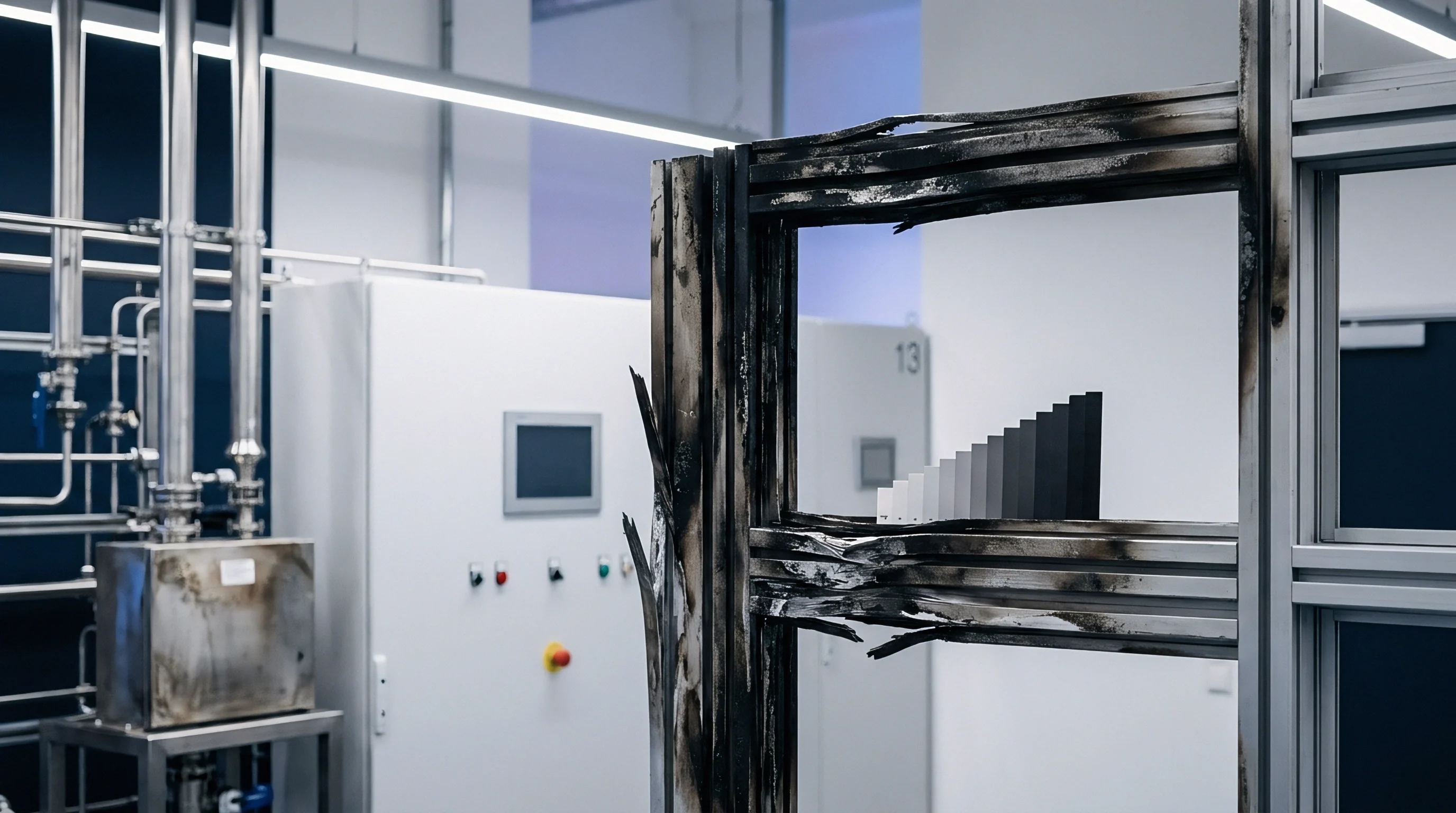

Flaw
Thermal contraction curves recorded between 293 Kelvin and 20 Kelvin show epoxy binder shrinking by 1.2 percent while hollow borosilicate microspheres contract by less than 0.06 percent. That differential shrinkage generates severe multiaxial tension at every sphere boundary. When a composite vessel chills to liquid nitrogen temperatures, hoop stress concentrates across resin ligaments narrower than five micrometers.
Microscopic ruptures appear long before mechanical pressure loads apply.
Each cooling sequence drives differential strain through the cell walls. Neat resin systems typically feature thermal expansion coefficients between 45 and 65 parts per million per Kelvin at ambient conditions. Hollow glass microspheres exhibit coefficients near 0.8 parts per million per Kelvin.
The resulting displacement mismatch forces the matrix into triaxial tension during chill-down. Once local strain exceeds the 0.4 percent tensile elongation limit of cryogenic epoxies, brittle shear bands snap open across adjacent microspheres. Structural continuity dissolves in discrete steps.
Cryogenic microcracking begins along the thinnest matrix walls between packed microspheres.
Damage accumulates along predictable morphological boundaries within the composite interior.
- Interfacial debonding severs the silane coupling layer between glass bubbles and crosslinked polymer, creating annular insulation gaps under thermal contraction.
- Intra-matrix ligament cleavage snaps narrow resin partitions between adjacent microspheres when inter-particle clearance drops below three micrometers. It occurs without external load.
- Microsphere wall buckling shatters thin-walled glass shells subjected to non-uniform hydrostatic compression by contracting resin fillets. Glass shards subsequently puncture adjacent cavities.
- Percolation crack channeling joins isolated matrix voids into macroscopic gas pathways spanning hundreds of micrometers across composite plies.
Acoustic emissions register these rupture events during early cooldown cycles. Signal transducers mounted to composite test coupons reveal high-amplitude bursts between 150 kilohertz and 400 kilohertz when coupon temperatures pass beneath 140 Kelvin. The rate of energy release accelerates as temperature approaches 77 Kelvin.
These acoustic bursts correlate directly with crack formation counts obtained from post-test optical microscopy. Microcrack density increases rapidly during initial cycles before leveling off toward a steady-state saturation limit.
Microcrack saturation represents a physical threshold governed by stress relaxation zones. Once crack spacing matches the characteristic stress transfer length of the resin ligament, local tensile stress cannot recover sufficient magnitude to fracture intact matrix sections. In typical syntactic formulations containing 40 volume percent glass bubbles, saturation occurs between eight and fourteen cracks per square millimeter of cross-section.
Cyclic strain fields below this density generate secondary branching. Material vendors frequently dismiss these initial microcracks as harmless non-propagating stress relief features that leave baseline bulk performance intact.


Flux
Heat conduction across damaged porous media decouples into lattice vibration transport and inter-cavity gas conduction. At 20 Kelvin, phonon mean free path in crosslinked resins reaches dozens of nanometers, making heat carrier transport sensitive to interfacial boundaries. Solid matrix conductivity drops when microcracks disrupt continuous phonon conduction corridors.
Concurrently, microcracks form planar gaps across which heat transfers via radiative exchange or gas molecules.
Thermal boundary resistance across microcracks governs effective conductivity at cryogenic temperatures. Acoustic mismatch between matrix polymer and fractured glass surfaces impedes vibrational wave packets. When surfaces separate by distances larger than acoustic wavelengths, phonon transmission drops to zero across the gap.
The crack functions as an insulating thermal barrier with boundary resistance scaling inversely with temperature cubed below 30 Kelvin.

What Governs Cryogenic Thermal Resistance at Microcracks?
Temperature fields across damaged syntactics depend on interfacial boundary resistance, crack orientation relative to the thermal gradient, and void evacuation levels. In pristine syntactic foams, hollow microspheres act as dispersed insulating inclusions within a conductive matrix. The Hasselman-Johnson modification of Maxwell-Garnett effective medium approximations predicts composite bulk conductivity by balancing matrix conductivity against inclusion volume fraction and interfacial thermal conductance.
Microcracking degrades this effective interfacial conductance parameter.
Microcracks oriented perpendicular to heat flow produce double the thermal resistance of longitudinal fissures.
The orientation of microcracks relative to heat flow vectors determines net thermal flux. Transverse microcracks directly intercept heat conduction pathways, forcing thermal energy around planar separations. Longitudinal cracks aligned parallel to thermal vectors produce negligible thermal resistance changes.
Analytical modeling requires treating microcrack damage as an anisotropic tensor rather than a scalar volume fraction modifier.
| Microcrack Density (cracks/mm²) | Conductivity At 293 K (W/m·K) | Conductivity At 77 K (W/m·K) | Conductivity At 20 K (W/m·K) | Conductivity At 4 K (W/m·K) |
|---|---|---|---|---|
| 0.0 (Pristine baseline) | 0.088 | 0.052 | 0.019 | 0.0062 |
| 2.5 (10 thermal cycles) | 0.084 | 0.048 | 0.016 | 0.0051 |
| 6.0 (50 thermal cycles) | 0.079 | 0.043 | 0.013 | 0.0039 |
| 11.5 (200 thermal cycles, saturated) | 0.071 | 0.036 | 0.010 | 0.0028 |
| 14.0 (500 cycles with mechanical load) | 0.066 | 0.031 | 0.008 | 0.0022 |
Under pristine vacuum isolation, microcracking systematically lowers effective thermal conductivity. Phonon scattering across void interfaces drops bulk conductivity at 20 Kelvin from 0.019 Watts per meter-Kelvin down to 0.010 Watts per meter-Kelvin after 200 cycles. That reduction pleases thermal designers operating isolated space payloads.
Terrestrial launch systems operate under different thermodynamic conditions. Evacuated microcracks under atmospheric exposure draw surrounding gases into open cells.
Molecular transport models break down when gas enters microscale apertures. When pore dimensions approach the mean free path of gas molecules, the Knudsen number exceeds unity. Heat transfer transitions from continuum gas conduction into free molecular regime where molecular collision frequency against cold crack faces governs energy exchange.
In deep space vacuum, microcracking reduces thermal transmission, but in ambient cryostat chambers, gas ingestion reverses that thermal insulating effect completely.

Gauge
Metrology tools for measuring thermal transmission under deep refrigeration present significant blind spots. Standard guarded hot plate apparatuses built to ASTM C177 specifications operate down to 77 Kelvin using liquid nitrogen cooling loops. Reaching liquid hydrogen temperatures at 20 Kelvin demands closed-cycle helium cryostats equipped with active radiation shielding and calibrated germanium resistance thermometers.
Precise evaluation requires stable boundary conditions that maintain sample compression without crushing damaged cellular structures.
Specimen clamping pressure exerts immediate effects on measured thermal conductivity. Mechanical compression forces separated microcrack faces back into physical contact. A clamping stress of 0.5 megapascals can restore 30 percent of phononic thermal contact across planar fractures, masking the true microcrack thermal resistance.
Measurements carried out without strict clamping pressure controls generate wildly erratic data points across identical test specimens.
A systematic experimental campaign follows an orderly sequence to quantify microcracking damage without introducing confounding mechanical artifacts.
- Specimen drying and baseline tomography maps initial void volume fractions, microsphere wall thickness distributions, and pre-existing processing voids at sub-micron resolution before cold exposure.
- Controlled cryogenic immersion dipping exposes unrestrained composite coupons to liquid nitrogen or liquid helium baths at controlled cooldown rates between one and five Kelvin per minute. Rapid quenching shatters brittle matrices instantly.
- Post-thermal acoustic characterization tracks ultrasonic wave velocity attenuation across coupon axes to calculate volumetric stiffness loss without destroying fragile internal microstructures.
- Guarded hot plate steady-state thermal testing measures axial heat flux under calibrated pneumatic clamping pressure in high-vacuum cryostats below ten microtorr.
- Permeation pressure-decay measurement quantifies open-porosity network growth by measuring helium gas leakage across specimen disks under differential pressure.
Laser flash analysis methods described in ASTM E1461 produce poor accuracy when applied to cracked syntactic composites. The laser pulse deposits concentrated energy onto front surfaces, creating steep local temperature rises that alter temperature-dependent phononic properties. Furthermore, porous materials scatter incident energy, causing non-uniform surface absorption.
Steady-state guarded hot plate methods remain the definitive technical choice for cryogenic thermal transport measurement.
ASTM C177 mandates continuous monitoring of edge heat losses through auxiliary guard heaters during steady-state composite testing.
Steady-state axial heat flow apparatuses built in accordance with ASTM E1225 evaluate cylindrical composite specimens positioned between calibrated reference bars. Applying copper reference cylinders allows direct determination of thermal heat flux through the syntactic core. Calibrating thermometer offsets remains difficult below 30 Kelvin.
Lake Shore Cernox sensors calibrated between 1.4 Kelvin and 325 Kelvin achieve measurement uncertainties within five millikelvin, eliminating temperature gradient drift.
| Measurement Instrument | Target Parameter | Operational Temperature Window | Resolution Limit | Primary Blind Spot |
|---|---|---|---|---|
| Guarded Hot Plate (Cryogenic) | Apparent thermal conductivity | 15 K to 300 K | ± 0.0008 W/m·K | Contact resistance sensitivity |
| Steady-State Axial Comparator | Directional heat flux | 4 K to 200 K | ± 0.0015 W/m·K | Lateral parasitic radiation loss |
| High-Resolution Micro-CT | Crack density and aperture width | 293 K (post-exposure) | 0.7 µm voxel size | Inability to scan at 20 K |
| Cryogenic Acoustic Emission | Real-time cracking onset | 4 K to 300 K | 100 kHz to 1 MHz | Wave attenuation in porous resin |
| Helium Pressure Decay Rig | Percolation leak rate | 77 K to 293 K | 1 × 10⁻¹⁰ mbar·L/s | Total exclusion of closed fissures |
| Thermal conductivity uncertainties reflect high-vacuum conditions below 10⁻⁵ mbar across 50 mm diameter test coupons. | ||||
Microstructural imaging faces physical constraints when resolving fine cryogenic microcracks. Laboratory micro-computed tomography systems operating with tungsten target tubes achieve spatial resolutions near one micrometer. Cryogenic microcracks often manifest with crack opening displacements below 300 nanometers.
Standard benchtop scans routinely miss 40 percent of microcrack networks. Synchrotron radiation sources provide phase-contrast imaging that detects sub-micron crack openings, but access costs exceed six thousand dollars per beamline shift.
Geological core analysts confront identical resolution limits when tracing sub-micron fracture networks through deep shale deposits. In both domains, macroscopic permeability readings consistently exceed values predicted by micro-computed tomography models. Fluid flows through interconnected fissures invisible to conventional radiographic absorption.
That cross-disciplinary metrology gap proves that non-destructive imaging must integrate with fluid transport measurements to capture damage.
Acoustic emissions monitoring provides continuous damage tracking without demanding synchrotron beamtime. Calibrated piezoelectric sensors bonded to specimens capture mechanical stress waves released during matrix rupture. Cumulative energy curves exhibit three distinct regimes: quiet baseline cooling, sudden burst activity at matrix yield, and plateauing emission during saturation.
Correlating acoustic energy against guarded hot plate conductivity readings yields an empirical calibration curve. Test engineers calculate thermal degradation without running hundred-hour steady-state cryostat trials.
Contractual agreements for aerospace tank insulation specify thermal performance adherence under ASTM C177 after two hundred thermal shock cycles, holding suppliers financially accountable for insulating drift.


Chill
Environmental gas ingestion turns microcrack development into a failure mechanism for cryogenic insulation systems. When a launch vehicle fuel tank fills with liquid hydrogen at 20 Kelvin, surrounding air cools past its condensation threshold. Unsealed microcracks create capillary channels that ingest surrounding nitrogen and oxygen gases.
Cryopumping action pulls atmospheric molecules deep into fractured syntactic foam cells. Trapped air condenses and freezes into solid frost lenses within the composite core.
Phase changes inside microcracks trigger thermal runaway. Solid nitrogen exhibits thermal conductivity near 0.25 Watts per meter-Kelvin, while liquid nitrogen conducts 0.13 Watts per meter-Kelvin. Dry syntactic foam conducts only 0.019 Watts per meter-Kelvin at identical temperatures.
Ingested cryogens short-circuit the insulating cellular structure, accelerating cryogenic propellant boil-off by 600 percent. The composite transitions from an insulator into a thermal conductor.

Will Cyclic Cryopumping Invert Thermal Insulation Performance?
Repetitive chilling and venting cycles expand microcrack networks through cyclic hydraulic pressure. Trapped cryogenic liquids boil violently when tanks warm to ambient conditions during vehicle turnaround. Expanding gas cannot vent quickly through narrow sub-micron fissures.
Internal pressure spikes to 20 megapascals, rupturing intact microspheres and opening secondary crack branches. Consecutive thermal cycles degrade syntactic foam through cyclical expansion.
Acoustic emission readings reveal matrix crack density surpassing 12 cracks per square millimeter after forty thermal shock cycles.
Material qualification campaigns evaluate syntactic composites against rigorous environmental criteria.
- Hermetic envelope integrity prevents atmospheric gas ingress into internal microcrack voids during tank chill-down. Polyimide films or aluminum foils provide external barriers.
- Permeation rate stability restricts helium gas leakage to less than 1 × 10⁻⁸ standard cubic centimeters per second across composite bulkheads. Excess leakage indicates through-thickness percolation paths.
- Thermal conductivity retention limits effective conductivity increases to less than twenty percent after two hundred full thermal cycles between 20 Kelvin and 340 Kelvin.
- Moisture uptake resistance prevents ambient humidity absorption during launch pad holds, eliminating explosive steam formation during launch heating.
Quantifying cyclic damage requires rigorous test protocols. Standard qualification programs expose composite panels to cyclic liquid hydrogen filling followed by hot nitrogen purges. Thermal cycling without atmospheric control generates misleading data.
Running test articles inside dry helium atmospheres suppresses condensation, masking catastrophic cryopumping failure modes that emerge on operational launch pads. Testing must duplicate flight atmospheres precisely.
Helium mass spectrometer leak testing identifies interconnected crack pathways long before thermal conductivity apparatuses register bulk heat flux shifts. Specimen disks mounted within dual-chamber vacuum flanges experience atmospheric helium pressure on one side while turbomolecular pumps maintain vacuum on the reverse face. When microcracks link up into continuous through-thickness paths, helium leak rates jump by four orders of magnitude within seconds.
Leak rate escalation confirms percolation threshold crossover.
Percolation theory dictates that randomly distributed microcracks form continuous through-thickness channels when crack volume fraction reaches 16 percent. In typical syntactic foams containing 40 volume percent glass spheres, this threshold corresponds to a microcrack density of 8.5 cracks per square millimeter. Below this threshold, microcracks remain isolated pockets.
Above this density, open fluid conduction pathways link opposing composite surfaces. Whether surface sealant coatings can bridge these expanding crack openings over thousands of thermal cycles remains an open engineering question.

Margin
Propellant boil-off rates directly determine orbital payload capacities. Launch vehicle architectures balance payload mass against structural insulation mass. Designers operating with unverified thermal conductivity models face severe mass penalties.
Assuming optimistic pristine conductivity values forces flight operations teams to vent excess boil-off propellant, shrinking satellite insertion margins. Adding excessive insulation thickness adds parasite mass that reduces revenue-generating customer payload capacity.
Cryogenic storage tanks carrying liquid hydrogen face boil-off penalties running hundreds of dollars per kilogram of vented propellant. If syntactic insulation microcracks during flight qualifications, thermal heat leaks increase boil-off rates from 0.15 percent to 0.85 percent per day. For a 30-tonne cryogenic upper stage loitering in orbit for three weeks, that performance gap represents four tonnes of lost propellant.
Space missions fail when fuel reserves boil away prematurely.
Procurement dossiers must specify microcrack-degraded thermal conductivity rather than pristine vendor datasheet values. Independent laboratory verifications cost between 35,000 and 70,000 dollars per qualification lot, covering cryogenic thermal cycling and guarded hot plate measurements at 20 Kelvin. Skimping on cryogenic verification testing exposes launch providers to catastrophic in-flight stage cutoffs, multi-million dollar payload write-downs, and complete mission failures.