Sub-Zero Frequency Hysteresis in Precision Quartz Resonators
Sub-zero frequency hysteresis in quartz resonators stems from mounting stress and cut geometry, requiring SC-cut ribbon mounts to hold sub-5 ppb stability.

Chill
When precision quartz crystal resonators are cooled below zero degrees Celsius, they undergo measurable frequency path dependency. Sweeping the temperature from positive twenty-five degrees down to negative forty degrees and back reveals distinct frequency outputs at identical sub-zero setpoints. This offset defines the sub-zero frequency hysteresis residual, expressed in parts per million or parts per billion.
As temperatures descend, mechanical stress between the crystal wafer and its metallic electrodes drives the primary thermal displacement curve.
Cut Geometry and Thermal Coefficients
AT-cut resonators rely on a thickness-shear mode operating near thirty-five degrees fifteen minutes of crystal lattice orientation. The third-order frequency-temperature polynomial for AT-cut quartz exhibits a turning point whose slope steepens rapidly below zero degrees Celsius. SC-cut resonators employ a double-rotated cut angle of twenty-two degrees fifteen minutes phi and thirty-three degrees fifteen minutes theta.
The stress-compensated nature of the SC-cut minimizes thermal stress sensitivity along crystallographic axes, reducing frequency shifts caused by non-uniform thermal gradients.
Gold plating applied to crystal surfaces introduces a thermal expansion coefficient mismatch relative to raw quartz crystal. Gold expands at fourteen point two microstrain per Kelvin, whereas quartz along the X-axis expands at thirteen point seven microstrain per Kelvin. Cooling the assembly to negative forty degrees contracts the gold layer faster than the underlying quartz substrate.
The resulting interfacial shear stress causes localized lattice deformation, shifting resonance frequencies away from room-temperature calibration curves.
An SC-cut crystal held at negative forty degrees Celsius yields a static thermal hysteresis band within two parts per billion when ramped at zero point zero five degrees per minute.
Thermal equilibrium lags behind ambient chamber temperatures during active cooling cycles. A crystal blank suspended inside a hermetically sealed TO-8 or surface-mount package absorbs heat through leads and trace bonds. Slow ramp rates allow thermal equilibration across the crystal disk, whereas fast ramp rates establish transverse thermal gradients between the active vibration center and perimeter clamp points, amplifying observed hysteresis values.
It remains unclear whether lattice impurity traps relax completely during extended sub-zero soaking periods.
Mounts
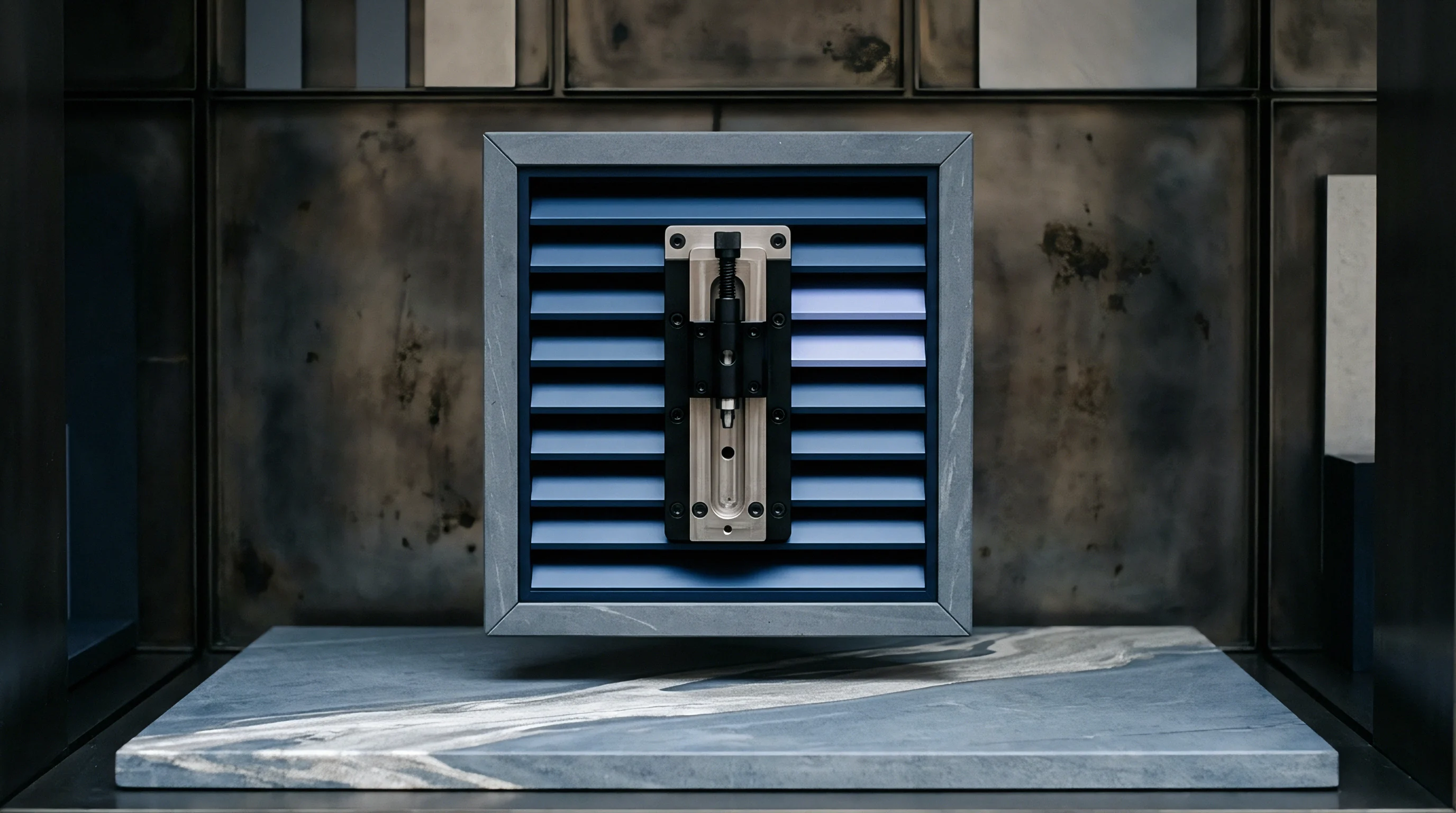
Structural elements holding quartz crystal blanks within package cavities govern how thermal contractions transfer into mechanical strain. Resonator blanks attach to package posts using conductive adhesives, ribbon clips, or micro-machined cantilever structures. Below zero degrees Celsius, organic adhesive materials cross their glass transition temperature thresholds, altering structural stiffness and dampening capabilities.
Adhesive Transition Physics
Silver-filled polyimide and epoxy adhesives experience elastic modulus shifts as temperatures decline toward negative forty degrees Celsius. Room-temperature modulus values near one point five gigapascals elevate to four point eight gigapascals at sub-zero extremes. This hardening converts compliant mounting points into rigid mechanical restraints, allowing minor dimensional differences in ceramic package bases or Kovar lead frames to transmit raw stress directly into the quartz disk edges.
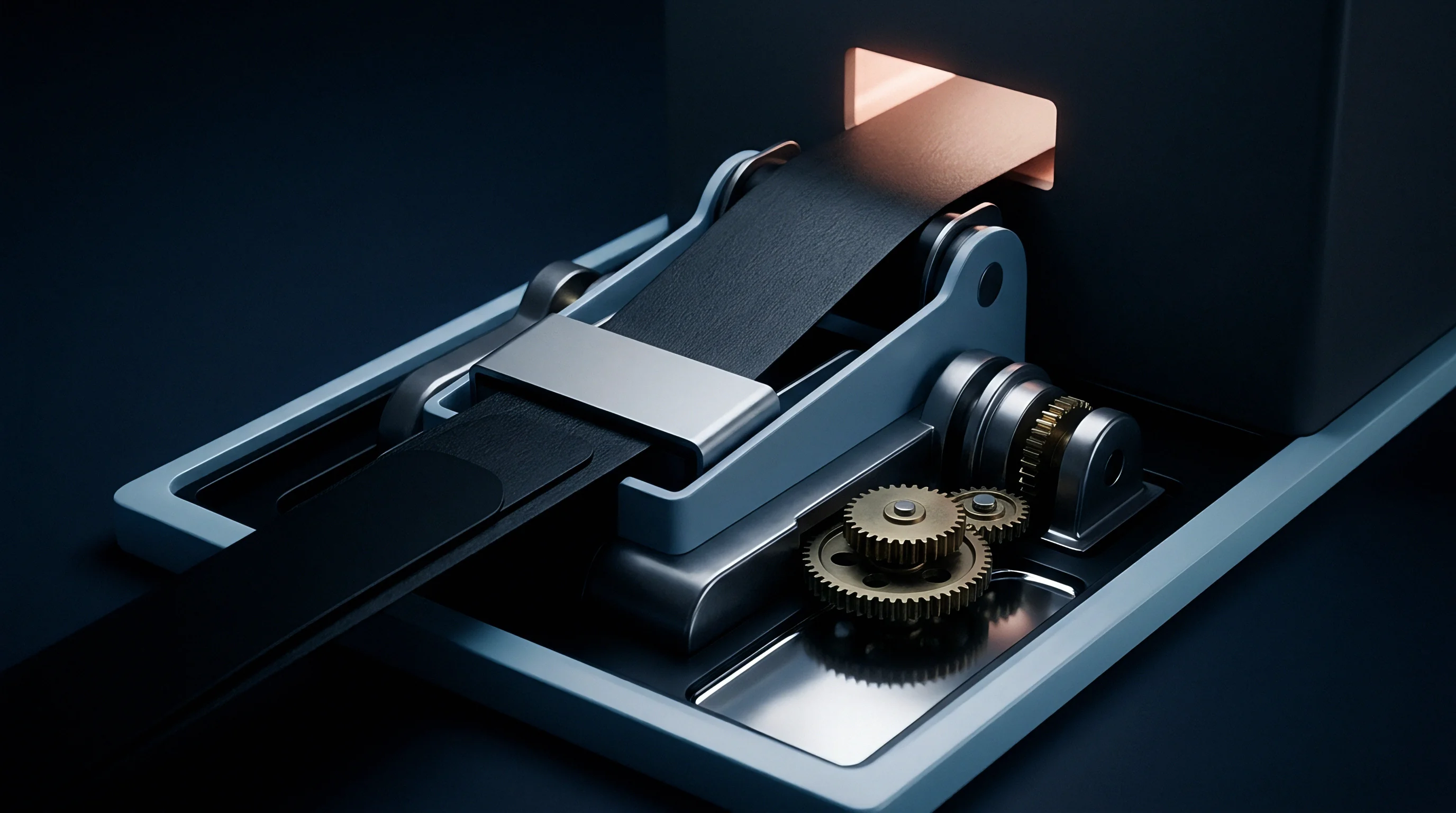
Stress relief geometry built into metal ribbon mounts absorbs mounting strain before forces reach the active acoustic volume. C-shaped and C-loop ribbon designs expand and contract elastically along defined flexural axes. Direct mounting with rigid epoxy drops acoustic Q factors while increasing hysteresis loop width across consecutive thermal cycles.
Structural failure mechanisms inside package cavity bounds degrade frequency stability under thermal stress.
- Epoxy Micro-Cracking originates near high-stress adhesive fillets during sub-zero thermal cycling, altering mechanical stiffness permanently.
- Outgassing Condensation deposits volatile organic compounds onto quartz electrode surfaces at temperatures below condensation thresholds, altering effective crystal mass.
- Lead Frame Mismatch induces axial torque across ceramic headers, transferring shear forces into crystal support clips.
- Solder Joint Creep shifts clip anchor locations slightly after repeated cooling, altering resting mechanical equilibrium.

Worked Construction of Thermal Stress Residuals
Evaluating an SC-cut ten megahertz quartz resonator operating at negative forty degrees Celsius demonstrates structural stress contribution to frequency offset. Assume a quartz crystal wafer disk of diameter eight point zero millimeters and thickness zero point one six six millimeters. The gold electrode layer measures two hundred nanometers in thickness on both major faces.
Conductive epoxy mounts anchor the crystal blank at two opposite edge points.
At positive twenty-five degrees, the crystal exhibits zero mounting stress baseline offset. Lowering temperature to negative forty degrees yields a temperature delta of negative sixty-five Kelvin. Gold contraction exceeds quartz contraction by zero point five microstrain per Kelvin, producing a net strain differential of thirty-two point five microstrain across the metal-quartz interface.
Multiplying interfacial strain by the elastic modulus of quartz along the X-axis yields an interfacial shear stress of approximately two point six megapascals. Applying the stress sensitivity coefficient of SC-cut quartz translates this internal shear force into a frequency displacement of three point eight parts per billion. If epoxy stiffening adds an extra one point two megapascals of boundary constraint force, the combined thermal-mechanical hysteresis displacement reaches five point five parts per billion upon warming back to zero degrees Celsius.
Repeated thermal cycling without mechanical stress relief permanently shifts baseline calibration points.
Metrics
Characterizing thermal hysteresis performance demands precise metrological parameters inside environmental test chambers. Frequency measurements captured during continuous thermal sweeps differ fundamentally from measurements taken after extended thermal dwell times. Standard specifications define hysteresis as the maximum frequency difference between heating and cooling branches over a designated operating temperature range.

Why Do Sub-Zero Thermal Sweeps Induce Irreversible Offset?
Thermal sweeps through negative ambient regions cause structural relaxation within electrode films and mounting media. Atomic dislocation movements inside metal plating realign under severe thermal strain gradients. When the crystal returns to positive twenty-five degrees Celsius, internal lattice micro-strains fail to recover their initial spatial distribution.
The crystal settles into an altered mechanical energy state, leaving a residual frequency offset termed thermal shock memory or dynamic hysteresis offset.
| Resonator Cut | Mounting System | Ramp Rate (°C/min) | Hysteresis Width (-40°C to 0°C) | Residual Offset at 25°C |
|---|---|---|---|---|
| AT-cut Standard | Rigid Conductive Epoxy | 1.0 | 45 ppb | 12 ppb |
| AT-cut Premium | Flexible Polyimide Clips | 1.0 | 18 ppb | 4 ppb |
| SC-cut Standard | Two-Point Epoxy Fillet | 0.5 | 6 ppb | 1.5 ppb |
| SC-cut High Stability | Ribbon Stress-Relieved Clips | 0.1 | 1.2 ppb | 0.3 ppb |
Datasheet specifications that report static frequency stability curves often hide hysteresis metrics behind wide tolerance bands. Operational validation demands documentation containing explicit measurement parameters.
Verification dossiers must contain specific testing parameters to validate sub-zero performance.
- Thermal Ramp Gradient documents the precise heating and cooling rate in degrees Celsius per minute across the complete test envelope.
- Soak Dwell Profiles state the minimum time duration allocated at sub-zero minimum setpoints before capturing frequency readings.
- Reference Oscillator Drift quantifies rubidium or cesium atomic clock reference stability throughout the measurement window.
- Sample Population Size identifies the lot size subjected to thermal cycling screening for statistical confidence calculations.
Contractual acceptance specs specifying sub-zero frequency stability trigger lot rejection rights when hysteresis loops exceed five parts per billion across the operating temperature window.
Inadequate thermal chamber air velocity control introduces false hysteresis readings by creating variable surface heat transfer coefficients across test fixtures, causing premature rejection of compliant production lots.
Testing
Operational verification of sub-zero frequency stability requires controlled instrumentation rigs capable of sub-part-per-billion resolution. Phase noise degradation and short-term frequency fluctuations increase when resonators experience sub-zero thermal stress. High-resolution frequency counters linked to low-noise buffer amplifiers extract exact frequency outputs during thermal transitions.
Environmental test chamber selection influences data integrity. Nitrogen gas purging prevents moisture frost accumulation on package pins and ceramic covers during sub-zero dips. Frost accumulation adds parasitic capacitance across terminal leads, masking true crystal resonator frequency movements under false electrical loading.
| Test Stage | Chamber Setpoint (°C) | Dwell Duration (min) | Measurement Target |
|---|---|---|---|
| Pre-Conditioning | +85 | 60 | Desorb surface moisture and establish baseline strain state |
| Cooling Sweep | +25 to -40 | 130 (at 0.5 °C/min) | Continuous frequency logging along descending thermal leg |
| Sub-Zero Soak | -40 | 120 | Isolate isothermal lattice relaxation from dynamic thermal lag |
| Warming Sweep | -40 to +25 | 130 (at 0.5 °C/min) | Continuous frequency logging along ascending thermal leg |
Quantifying sub-zero hysteresis performance relies on a sequential laboratory procedure.
- Mount sample quartz resonators inside a thermal test fixture featuring non-inductive heater blocks and gold-plated sockets.
- Connect output pins to a multi-channel frequency counter referenced to a local rubidium atomic standard.
- Purge the chamber cavity with dry nitrogen gas until internal dewpoint readings drop below negative sixty degrees Celsius.
- Lower chamber temperature from positive twenty-five degrees down to negative forty degrees at a controlled rate of zero point five degrees per minute.
- Record frequency readings at every zero point five degree increment during the cooling descent.
- Hold ambient temperature at negative forty degrees for two hours to reach full internal thermal equilibrium.
- Raise chamber temperature back to positive twenty-five degrees at zero point five degrees per minute while capturing ascending frequency points.
- Calculate the maximum vertical delta between descending and ascending frequency curves at identical temperature points across the sub-zero range.
Sub-zero frequency hysteresis loops stem from moisture condensation on external test sockets or internal crystal mounting stress.

Contracts
Procurement documents for high-reliability quartz resonators specify dynamic parameters alongside conventional static frequency tolerances. Standard commercial specifications quote frequency-temperature stability as a total peak-to-peak envelope. This practice leaves room for wide hysteresis loops that degrade system-level phase-locked loop tracking performance in cold outdoor environments.
Incorporating explicit sub-zero hysteresis clauses inside procurement technical data packages shifts quality validation back to component manufacturers. High-grade military and telecommunications buyers specify maximum allowable hysteresis envelope widths across the full operating range from negative forty degrees to positive eighty-five degrees Celsius. Yield fallouts during factory screening directly impact finished component unit pricing.
Selecting SC-cut resonators mounted on ribbon flex structures increases raw component unit costs by three hundred to five hundred percent relative to standard AT-cut units. Paying this premium avoids downstream field failures, system recalibration service calls, and receiver unlock conditions in sub-zero operational deployments. Demand measurement instruments prove that purchasing lower-cost resonators without thermal hysteresis guarantees leads to unbudgeted redesign expenses during field validation testing.
Unscreened quartz resonators exhibit sub-zero hysteresis variation five times wider than units validated through automated thermal sweep protocols.
Standard procurement master service agreements incorporate clause 4.8.2 for precision frequency control devices, enforcing automated lot sampling rejection whenever thermal hysteresis loop width exceeds three parts per billion across negative forty to zero degrees Celsius.